
This page covers how SELinux policy is built. SELinux policy is built from
the combination of core AOSP policy (platform) and device-specific policy
(vendor). The SELinux policy build flow for Android 4.4 through Android
7.0 merged all sepolicy fragments then generated monolithic files in the root
directory. This meant that SoC vendors and ODM manufacturers modified
boot.img
(for non-A/B devices) or system.img (for A/B devices) every time policy was
modified.
In Android 8.0 and higher, platform and vendor policy is built separately.
SoCs and OEMs can update their parts of the policy, build their images
(such as vendor.img and boot.img),
then update those images independent of platform
updates.
However, as modularized SELinux policy files are stored on /vendor
partitions, the init process must mount the system and vendor
partitions earlier so it can read SELinux files from those partitions and merge
them with core SELinux files in the system directory (before loading them into
the kernel).
Source files
The logic for building SELinux is in these files:
-
external/selinux: External SELinux project, used to build HOST command line utilities to compile SELinux policy and labels.-
external/selinux/libselinux: Android uses only a subset of the externallibselinuxproject along with some Android-specific customizations. For details, seeexternal/selinux/README.android. -
external/selinux/libsepol: -
external/selinux/checkpolicy: SELinux policy compiler (host executables:checkpolicy,checkmodule, anddispol). Depends onlibsepol.
-
-
system/sepolicy: Core Android SELinux policy configurations, including contexts and policy files. Major sepolicy build logic is also here (system/sepolicy/Android.mk).
For more details on the files in system/sepolicy, see
Key files.
Android 7.x and lower
This section covers how SELinux policy is built in Android 7.x and lower.
Build process for Android 7.x and lower
SELinux policy is created by combining the core AOSP policy with device-specific
customizations. The combined policy is then passed to the policy compiler and
various checkers. Device-specific customization is done through the
BOARD_SEPOLICY_DIRS variable defined in device-specific
Boardconfig.mk file. This global build variable contains a list of
directories that specify the order in which to search for additional policy files.
For example, an SoC vendor and an ODM might each add a directory, one for the SoC-specific settings and another for device-specific settings, to generate the final SELinux configurations for a given device:
BOARD_SEPOLICY_DIRS += device/SoC/common/sepolicyBOARD_SEPOLICY_DIRS += device/SoC/DEVICE/sepolicy
The content of file_contexts files in system/sepolicy and
BOARD_SEPOLICY_DIRS are concatenated to generate the
file_contexts.bin on the device:
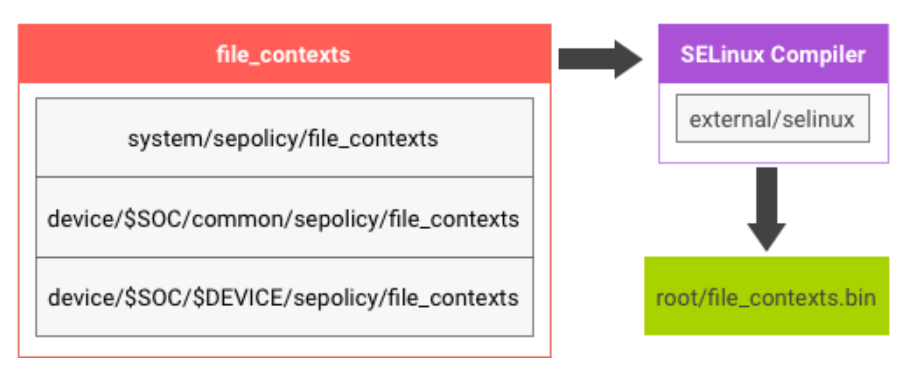
Figure 1. SELinux build logic.
The sepolicy file consists of multiple source files:
- The plain text
policy.confis generated by concatenatingsecurity_classes,initial_sids,*.tefiles,genfs_contexts, andport_contextsin that order. - For each file (such as
security_classes), its content is the concatenation of the files with the same name undersystem/sepolicy/andBOARDS_SEPOLICY_DIRS. - The
policy.confis sent to SELinux compiler for syntax checking and compiled into binary format assepolicyon the device.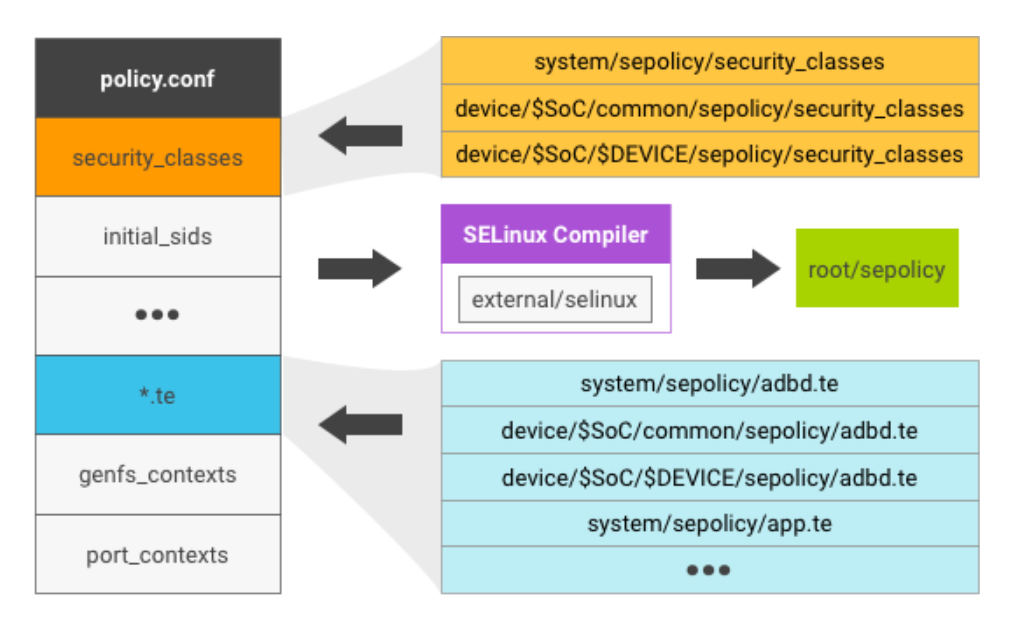
Figure 2. SELinux policy file.
SELinux files
After compiling, Android devices running 7.x and earlier typically contain the following SELinux-related files:
selinux_versionsepolicy: Binary output after combining policy files (such assecurity_classes,initial_sids, and*.te)file_contextsproperty_contextsseapp_contextsservice_contextssystem/etc/mac_permissions.xml
For more details, see Implement SELinux.
SELinux initialization
When the system boots up, SELinux is in permissive mode (and not in enforcing mode). The init process performs the following tasks:
- Loads
sepolicyfiles from ramdisk into the kernel through/sys/fs/selinux/load. - Switches SELinux to enforcing mode.
- Runs
re-exec()to apply the SELinux domain rule to itself.
To shorten the boot time, perform the re-exec() on the
init process as soon as possible.
Android 8.0 and higher
In Android 8.0, SELinux policy is split into platform and vendor components to allow independent platform and vendor policy updates while maintaining compatibility.
The platform sepolicy is further split into platform private and platform public parts to export specific types and attributes to vendor policy writers. The platform public types/attributes are guaranteed to be maintained as stable APIs for a given platform version. Compatibility with previous platform public types/attributes can be guaranteed for several versions using platform mapping files.
Build process for Android 8.0
SELinux policy in Android 8.0 is made by combining pieces from
/system and /vendor. Logic for setting this up
appropriately is in
/platform/system/sepolicy/Android.bp.
The policy exists in the following locations:
| Location | Contains |
|---|---|
system/sepolicy/public |
Platform sepolicy API |
system/sepolicy/private |
Platform implementation details (vendors can ignore) |
system/sepolicy/vendor |
Policy and context files that vendors can use (vendors can ignore) |
BOARD_SEPOLICY_DIRS |
Vendor sepolicy |
BOARD_ODM_SEPOLICY_DIRS (Android 9 and higher) |
ODM sepolicy |
SYSTEM_EXT_PUBLIC_SEPOLICY_DIRS (Android 11 and higher) |
system_ext sepolicy API |
SYSTEM_EXT_PRIVATE_SEPOLICY_DIRS (Android 11 and higher) |
system_ext implementation details (vendors can ignore) |
PRODUCT_PUBLIC_SEPOLICY_DIRS (Android 11 and higher) |
Product sepolicy API |
PRODUCT_PRIVATE_SEPOLICY_DIRS (Android 11 and higher) |
Product implementation details (vendors can ignore) |
The build system takes this policy and produces system, system_ext,
product, vendor, and odm policy components on the
corresponding partition. Steps include:
- Convert policies to the SELinux Common Intermediate Language (CIL)
format, specifically:
- Public platform policy (
system,system_ext,product) - Combined private and public policy
- Public, vendor, and
BOARD_SEPOLICY_DIRSpolicy
- Public platform policy (
- Version the policy provided by public as part of the vendor policy.
Use the produced public CIL policy to inform the combined public and
vendor and
BOARD_SEPOLICY_DIRSpolicy as to which parts must be turned into attributes that are linked to the platform policy. - Create a mapping file linking the platform and vendor parts. Initially, this just links the types from the public policy with the corresponding attributes in the vendor policy; later it also provides the basis for the file maintained in future platform versions, enabling compatibility with vendor policy targeting this platform version.
- Combine policy files (describe both on-device and precompiled solutions).
- Combine mapping, platform, and vendor policy.
- Compile output binary policy file.
Platform public sepolicy
The platform public sepolicy includes everything defined under
system/sepolicy/public. The platform can assume the types and
attributes defined under public policy are stable APIs for a given platform
version. This forms the part of the sepolicy that is exported by the platform on
which vendor (that is, device) policy developers can write additional
device-specific policy.
Types are versioned according to the version of the policy that vendor
files are written against, defined by the PLATFORM_SEPOLICY_VERSION
build variable. The versioned public policy is then included with the
vendor policy and (in its original form) in the platform policy. Thus,
the final policy includes the private platform policy, the current platform's
public sepolicy, the device-specific policy, and the versioned public policy
corresponding to the platform version against which the device policy was
written.
Platform private sepolicy
The platform private sepolicy includes everything defined under
/system/sepolicy/private. This part of the policy forms
platform-only types, permissions, and attributes required for platform
functionality. These aren't exported to the vendor and device policy
writers. Nonplatform policy writers must not write their policy extensions
based on types, attributes, and rules defined in the platform private sepolicy. Moreover,
these rules are allowed to be modified or might disappear as part of a framework-only update.
Platform private mapping
The platform private mapping includes policy statements that map the attributes
exposed in platform public policy of the previous platform versions to the
concrete types used in current platform public sepolicy. This ensures
vendor policy that was written based on platform public attributes from
the previous platform public sepolicy versions continues to work. The
versioning is based on the PLATFORM_SEPOLICY_VERSION build variable
set in AOSP for a given platform version. A separate mapping file exists for
each previous platform version from which this platform is expected to accept
vendor policy. For more details, see
Policy compatibility.
Android 11 and higher
This section covers how SELinux policy is built in Android 11 and higher.
system_ext and product sepolicy
In Android 11, system_ext policy and product policy are added. Like
the platform sepolicy, system_ext policy and product policy are split into
public policy and private policy.
Public policy is exported to vendor. Types and attributes become stable API, and
vendor policy can refer to types and attributes in the public policy. Types are
versioned according to PLATFORM_SEPOLICY_VERSION, and the versioned
policy is included to the vendor policy. The original policy is included to each
of system_ext and product partition.
Private policy contains system_ext-only and product-only types, permissions, and
attributes required for system_ext and product partition functionality.
Private policy is invisible to vendor, implying that these rules are internal
and allowed to be modified.
system_ext and product mapping
system_ext and product are allowed to export their designated public types to
vendor. However, each partner has the responsibility to maintain
compatibility. For compatibility, partners can provide their own
mapping files which map the versioned attributes of previous versions to
concrete types used in current public sepolicy:
- To install a mapping file for
system_ext, place a CIL file containing the desired mapping information to{SYSTEM_EXT_PRIVATE_SEPOLICY_DIRS}/compat/{ver}/{ver}.cil, and then addsystem_ext_{ver}.ciltoPRODUCT_PACKAGES. - To install a mapping file for
product, place a CIL file containing the desired mapping information to{PRODUCT_PRIVATE_SEPOLICY_DIRS}/compat/{ver}/{ver}.cil, and then addproduct_{ver}.ciltoPRODUCT_PACKAGES.
Refer to an
example
that adds a mapping file of a Redbull device's product partition.
Precompiled SELinux policy
Before init turns on SELinux, init gathers all CIL files from partitions
(system, system_ext, product, vendor and
odm) and compiles them into binary policy, the format which can be loaded to kernel. As
the compilation takes time (usually 1-2 seconds), the CIL files are precompiled at build time and
placed at either /vendor/etc/selinux/precompiled_sepolicy or
/odm/etc/selinux/precompiled_sepolicy, along with the sha256 hashes of the input CIL
files. At runtime, init checks if any of the policy file has been updated by comparing
the hashes. If nothing has changed, init loads the precompiled policy. If not,
init compiles on the fly and uses it instead of the precompiled one.
More specifically, precompiled policy is used if all of the following conditions are met. Here,
{partition} represents the partition where the precompiled policy exists: either
vendor or odm.
- Both
/system/etc/selinux/plat_sepolicy_and_mapping.sha256and/{partition}/etc/selinux/precompiled_sepolicy.plat_sepolicy_and_mapping.sha256exist and are identical. - Both
/system_ext/etc/selinux/system_ext_sepolicy_and_mapping.sha256and/{partition}/etc/selinux/precompiled_sepolicy.system_ext_sepolicy_and_mapping.sha256don't exist. Or both exist and are identical. - Both
/product/etc/selinux/product_sepolicy_and_mapping.sha256and/{partition}/etc/selinux/precompiled_sepolicy.product_sepolicy_and_mapping.sha256don't exist. Or both exist and are identical.
If any of them differ, init falls back to the on-device compilation path. See
system/core/init/selinux.cpp for more details.